
PU Conveyor Belt Supplier for Food, Pharma & Packaging Industries: Tips for Choosing the Right Conveyor System Manufacturer
Best PU Conveyor Belt Supplier in India
This guide helps procurement managers, plant engineers, and business owners in the food processing, pharmaceutical, and packaging industries make a confident, informed decision when selecting a PU conveyor belt supplier. By the end of this article, you will know exactly what to look for, what to avoid, and why Jagruti Conveyor Belts Pvt. Ltd. stands among India's most trusted manufacturers and exporters of hygienic polyurethane conveyor belts serving buyers across India, the Middle East, Africa, and Southeast Asia.
PU Conveyor Belt Systems Importance in Key Industries
After more than seven decades of watching industries rise and fall on the strength or weakness of their material handling systems, I can tell you this with complete certainty: the conveyor belt you choose is not merely a purchasing decision. It is a production decision, a hygiene decision, and ultimately, a business survival decision.
Nowhere is this truer than in food processing, pharmaceutical manufacturing, and packaging - three sectors where a wrong belt choice can trigger regulatory shutdowns, product recalls, and reputational damage that no marketing budget can repair.
Polyurethane conveyor belts manufacturers have emerged as the material of choice across these critical industries and for very good reason. But choosing the right PU conveyor belt supplier is a science in itself. Let me walk you through what matters most.
Why PU Conveyor Belts Are the Industry Standard for Sensitive Applications?
Before evaluating conveyor belt suppliers, you must understand why PU (polyurethane) has displaced older belt materials in hygienic, precision-driven environments. PU conveyor belts offer a combination of properties that no other belt material currently matches for food-grade, pharmaceutical, and packaging applications:
- Superior wear resistance - outlasting rubber conveyor belts and standard PVC belts in continuous-operation environments
- Food-grade compliance - resistant to food oils, fats, acids, and cleaning chemicals; meeting standard regulations
- Smooth, non-porous surfaces - preventing bacterial growth and enabling deep-clean protocols critical for certified facilities
- Dimensional stability - maintaining consistent tension and tracking even under temperature variation
- Colour-coded safety options - available in white, green, blue, and black to support contamination control programs
- Chemical resistance - standing up to sanitisers, solvents, and process fluids without surface degradation
In biscuit manufacturing, dairy processing, pharmaceutical tableting lines, and food packaging plants, these properties of PU conveyor belt system suppliers are not luxury features but are minimum requirements for operational success in these high-stakes industries.
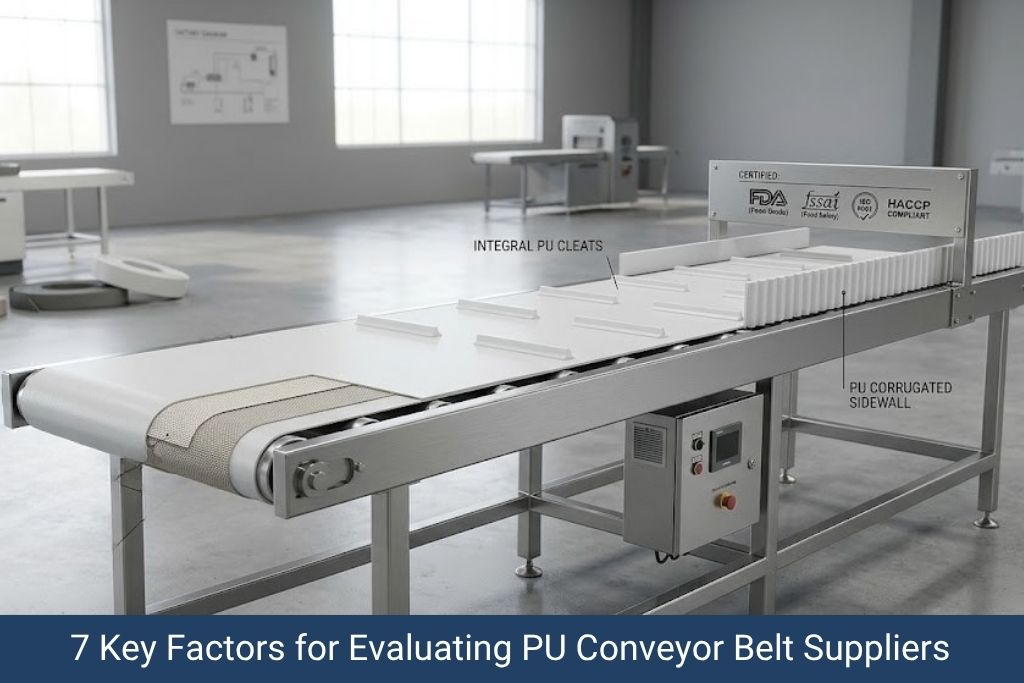
PU Conveyor Belt Critical Factors: Every Buyer Must Evaluate
PU Conveyor Belt Manufacturing Capability Comes Before Everything Else
A credible supplier does not merely stock PU belts but they manufacture them. The distinction matters enormously. Ask every potential supplier these questions before going further:
- Do you manufacture in-house, or are you a reseller?
- Can you produce Cleated PU Conveyor Belts with custom cleat heights and spacing?
- Can you fabricate Sidewall PU Conveyor Belts for vertical and steep-incline applications?
- What is your production capacity for custom widths, lengths, and ply configurations?
Suppliers who offer specialised variants like cleated belts for inclined food transport, sidewall belts for bulk containment, smooth-surface hygienic belts for dairy and pharma — demonstrate deep manufacturing knowledge, not just catalogue depth.
Food-Grade PU Conveyor Belt Certification Must Be Documented, Not Assumed
Any supplier claiming to serve food processing or pharmaceutical clients must provide documented proof of material compliance. This includes:
- Food-grade polyurethane certifications - FDA, FSSAI & ISO, or equivalent
- HACCP compatibility - belt surfaces that can withstand CIP (Clean-In-Place) and SIP (Sterilise-In-Place) protocols
- RoHS and REACH compliance - mandatory for export to European markets
- Absence of plasticisers and harmful additives that could migrate into food products
Never accept a supplier's verbal assurance. Request certificates. A trustworthy PU belt conveyor system manufacturer will provide them without hesitation.
PU Conveyor Belt Exporters: Why Global Supply Capability Matters?
If your operations span multiple countrie or if you are procuring on behalf of a facility in the UAE, Saudi Arabia, Kenya, Southeast Asia, or Europe then your conveyor belt supplier's export credentials become critical. Look for:
- Documented export history to your target region
- Familiarity with international packaging, labelling, and customs documentation
- Ability to offer FOB, CIF, and DAP pricing
- Experience with export compliance for food-contact and industrial goods
India's conveyor belt manufacturers, particularly those based in Gujarat have established strong export pipelines to the Middle East, Africa, and Southeast Asia. However, not every manufacturer has the logistical infrastructure or quality systems to serve international buyers reliably.
 Drop Us an Email!
Cleated PU Conveyor Belts and Sidewall Variants: Customisation Range Is Non-Negotiable
Food, pharma, and packaging industries demand customisation not off-the-shelf solutions. Evaluate whether your supplier can deliver:
- Cleated PU Conveyor Belts - with varying cleat heights (15mm, 25mm, 32mm, 45mm+), cleat profiles (T-cleats, L-cleats, corrugated), and spacings for biscuit lines, fruit and vegetable handling, and pharmaceutical tablet conveyance
- Sidewall PU Conveyor Belts - with corrugated sidewalls for steep-angle bulk material conveyance without spillage
- Rough-top and diamond-top PU belt finishes - for grip-sensitive applications on moderate inclines
- FDA-white, blue-detectable, and contrast-colour variants - for contamination detection programs
A supplier who can only offer one or two standard profiles will constrain your operational design. Seek a reputed PU conveyor belt manufacturer in India with an engineering team that treats your application as a starting point, not a limitation.
Hygienic Conveyor Belt Quality Control Must Be Systematic, Not Selective
Ask every potential PU conveyor belt supplier about their quality testing protocols:
- What internal tests do you perform — tensile strength, elongation at break, abrasion resistance, adhesion between plies?
- Do you conduct batch-level testing or only product-level sampling?
- What is your process for identifying and quarantining non-conforming product?
Belt failures in food processing and pharmaceutical plants are not merely operational inconveniences — they can trigger contamination events and regulatory investigations. Your supplier's quality culture must be non-negotiable.
Our Other Product
Conveyor Roller SystemConveyor Belt Supplier After-Sales Support: Installation, Maintenance, and Replacement
The best PU conveyor belt is only as good as its installation and ongoing maintenance. Evaluate:
- Does the supplier offer conveyor belt installation services in your region?
- Can they provide maintenance training for your engineering team?
- Do they stock replacement belts or maintain minimum inventory commitments for critical clients?
- What is their typical lead time for replacement supply — especially important for export markets where shipping windows matter?
In hygienic industries, unplanned downtime is catastrophic. A polyurethane conveyor belt supplier with strong after-sales support is worth a premium over one who disappears after delivery.
PU Conveyor Belt Price vs Total Cost of Ownership: What Smart Conveyor Belt Buyers Calculate?
The lowest-quoted PU conveyor belt is rarely the most economical over its operating life. Evaluate total cost of ownership across these dimensions:
- Initial belt cost per metre, including custom fabrication
- Expected service life under your specific load, speed, and cleaning chemistry conditions
- Maintenance frequency and ongoing cost
- Downtime cost if belt failure occurs mid-production
- Replacement lead time and freight cost for international buyers
Even at 20-30% higher initial cost, a premium-grade conveyor belt manufacturers in Gujarat, India delivers two to three times the service life of a budget alternative. The arithmetic almost always favours quality.
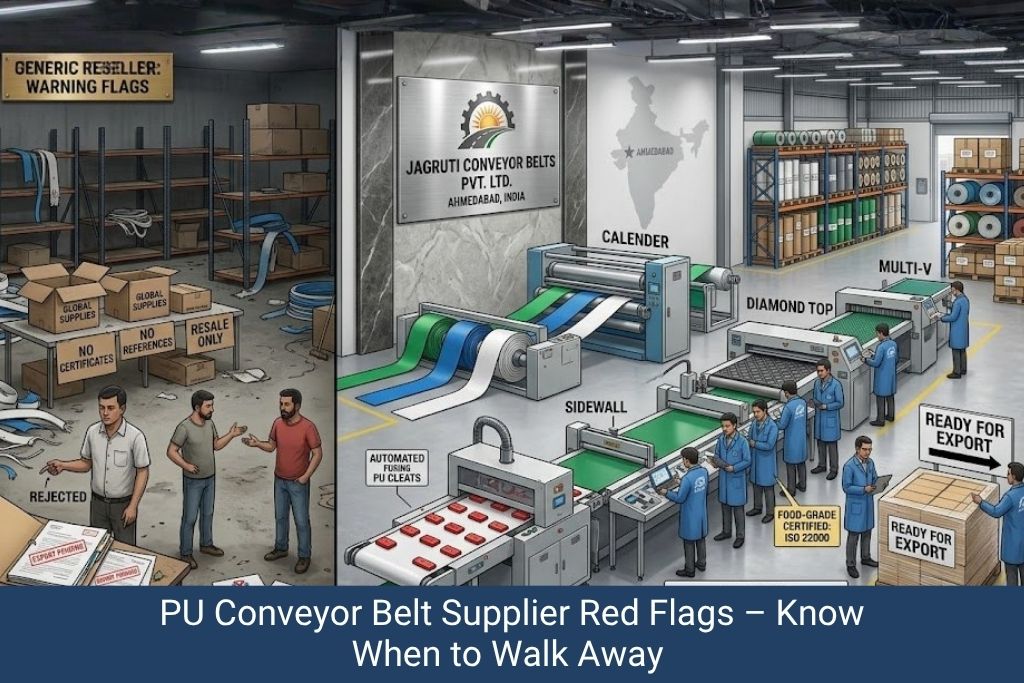
PU Conveyor Belt Supplier Red Flags: Know When to Walk Away
In decades of industry experience, certain signals reliably predict future problems. Walk away from any PU conveyor system supplier who:
- Cannot provide material compliance certificates — a fundamental disqualifier for food and pharma applications
- Does not manufacture in-house — resellers cannot guarantee quality, lead times, or customisation capability
- Has no reference customers in your specific industry — food-grade belt expertise is not transferable from general industrial applications
- Has unclear or undocumented export experience — critical for any buyer outside the supplier's home market
- Offers no after-sales engineering support — a sign of a transactional, not partnership, mindset
India's Trusted PU Conveyor Belt Manufacturer and Exporter – Jagruti Conveyor Belts Pvt. Ltd.
For over two decades, Jagruti Conveyor Belts Pvt. Ltd. has earned its standing as one of the most trusted conveyor belt manufacturers in Ahmedabad, Gujarat, India for food processing, pharmaceutical, packaging, and chemical industries across India and internationally.
Here is why discerning buyers across India, the Middle East, Africa, and Southeast Asia choose Jagruti:
- In-house manufacturing of the complete PU belt range including Cleated, Sidewall, Smooth Top, Diamond Top, and Multi-V profile belts across all standard widths and custom configurations
- Food-grade polyurethane materials meeting international hygiene and compliance standards, suitable for direct and indirect food contact
- Full colour range like white, green, blue, and black PU belts, including FDA-white variants for pharmaceutical and food-grade applications
- Proven export capability serving buyers across the UAE, Saudi Arabia, Kenya, Nigeria, Malaysia, and Europe with complete documentation and export compliance
- Engineering customisation such as bespoke cleat heights, sidewall profiles, special surface finishes, and custom belt lengths fabricated to exact application specifications
- Competitive pricing with transparent cost structures for both domestic and export buyers
- Dedicated after-sales support with installation guidance, maintenance consultation, and responsive replacement supply
When your food processing line, pharmaceutical tableting conveyor, or packaging system demands a hygienic, durable, compliant PU belt - Jagruti Conveyor Belts Pvt. Ltd. delivers not just a product, but a partnership built on engineering excellence and decades of application expertise.
Contact Jagruti Conveyor Belts Pvt. Ltd. today for a customised quote, compliance documentation, and technical consultation.
PU Conveyor Belt Supplier in India: Frequently Asked Questions
PU conveyor belts offer superior chemical resistance, a smooth surface that resists bacterial growth, and FDA/EU compliance, making them ideal for food processing and pharmaceutical industries, unlike PVC or rubber belts.
Jagruti Conveyor Belts Pvt. Ltd., based in Ahmedabad, Gujarat, is a top manufacturer of food-grade PU conveyor belts, offering various options for food processing, dairy, pharmaceutical, and packaging sectors.
PU conveyor belts are widely used in food processing, pharmaceuticals, packaging, chemicals, and cosmetics due to their hygiene standards and chemical resistance.
Cleated PU belts are ideal for inclined conveyors, preventing product rollback, especially in food and pharmaceutical applications. Flat belts are best for horizontal, level surfaces.
Jagruti Conveyor Belts Pvt. Ltd. exports PU conveyor belts to the UAE, Australia, Saudi Arabia, Kenya, Nigeria, Malaysia, and more, offering full export documentation and competitive pricing.
PU belts are typically 15–35% more expensive than PVC but provide better value due to longer service life, lower maintenance, and fewer downtimes in food-grade applications.
PU conveyor belts for food use must comply with FDA, FSSAI & ISO standards for pharmaceutical applications.
Top importers of Indian PU conveyor belts include countries in the UAE, Saudi Arabia, South Africa, Malaysia, and Southeast Asia, particularly for their competitive pricing and quality.
Ask suppliers about food-grade compliance, customization options, lead times, export experience, testing procedures, and after-sales support to ensure quality and reliability.