
PU vs PVC vs Chevron Conveyor Belts: Which Conveyor Belt is Best for Your Industry?
PU vs PVC vs Chevron Conveyor Belts Manufacturer, Exporter and Wholesale Supplier:
This complete buyer's guide is written for plant engineers, production managers, and procurement professionals who need to choose confidently between PU conveyor belts, PVC conveyor belts, and Chevron conveyor belts. By the end of this article, you will understand the precise conditions under which each belt type performs best and how Jagruti Conveyor Belts Pvt. Ltd., one of India's leading conveyor belt manufacturers and exporters, can supply the exact belt your application demands, whether you are based in India, the UAE, Africa, or anywhere across the globe.
This guide compares the three belt types that dominate light-to-medium industrial, food, pharmaceutical, packaging, and agricultural applications: PU (polyurethane) conveyor belts, PVC conveyor belts, and Chevron conveyor belts explaining precisely when each earns its place, and when choosing the wrong one costs you far more than the price of the belt itself.
 Call Us Now!
What PU Conveyor Belts Are and Where They Excel?
PU conveyor belts are manufactured from thermoplastic polyurethane, a synthetic elastomer that combines the flexibility of rubber with the chemical resistance and surface precision of engineering plastics. They are the belt of choice wherever hygiene, food-grade compliance, and long service life are non-negotiable.
PU conveyor belt core properties:
- Non-porous, smooth or textured surface that resists bacterial adhesion
- Resistant to food oils, fats, cleaning chemicals, sanitisers, and mild solvents
- Complies with food-contact standards
- Available in multiple surface finishes: smooth, rough top, diamond top, multi-V, and cleated
- Available in food-safe colours: white, green, blue, and black
- Excellent dimensional stability and low elongation under load
- Operating temperature range: approximately -30°C to +80°C in standard grades
PU conveyor belt variants used across industries:
- Cleated PU Conveyor Belts - with raised vertical cleats for inclined product transport without slippage
- Sidewall PU Conveyor Belts - with corrugated lateral walls for steep-angle bulk conveyance
- Smooth hygienic PU belts - for direct food contact, dairy lines, and pharmaceutical conveyance
What PVC Conveyor Belts Are and Where They Excel?
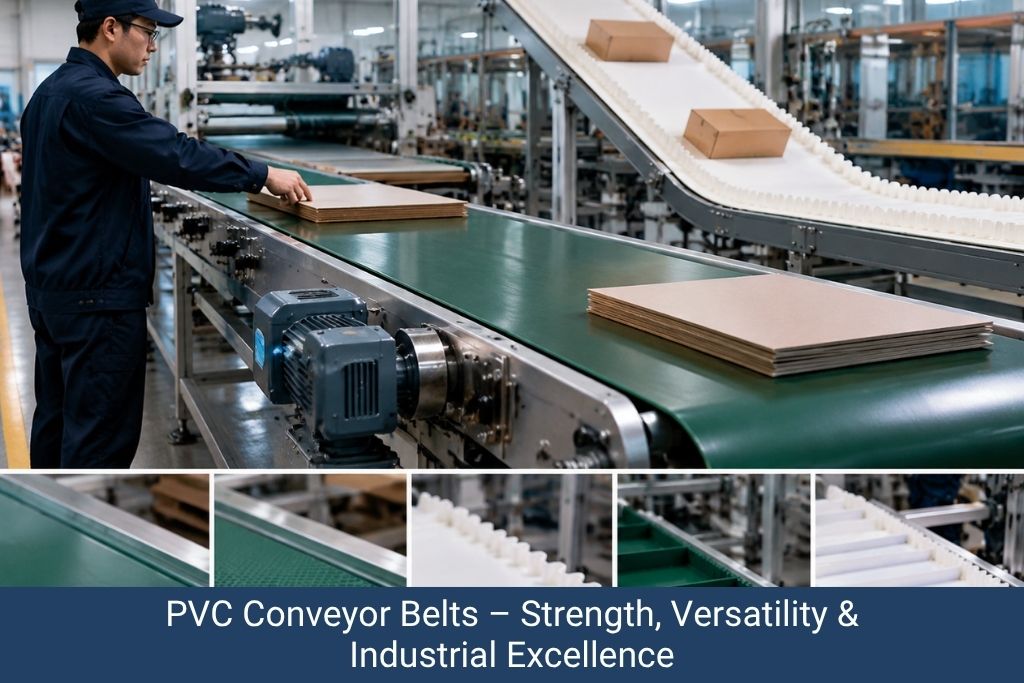
PVC conveyor belts are the workhorses of light-to-medium industrial material handling. Manufactured from a layered construction of PVC compound over a woven polyester or nylon fabric carcass, they offer an excellent combination of strength, versatility, and cost efficiency for applications where food-grade compliance is not the primary driver.
PVC conveyor belt core properties:
- Good tensile strength and load-bearing capability relative to cost
- Moderate chemical resistance, with oil-resistant grades available
- Available in 1-ply through 4-ply constructions for varying load requirements
- Multiple surface finishes: smooth, rough top, diamond top, wavy top, sidewall, and cleated
- Lower unit cost than PU belts of comparable dimensions
- Somewhat more porous surface than PU and less ideal for the most stringent hygiene environments
PVC conveyor belt variants:
- 1-ply, 2-ply, 3-ply, and 4-ply PVC conveyor belts for light to heavy load applications
- PVC sidewall conveyor belts and PVC cleated conveyor belts for inclined handling
- Green, black, white, and blue PVC belts for colour-coded production environments
What Chevron Conveyor Belts Are and Where They Excel?
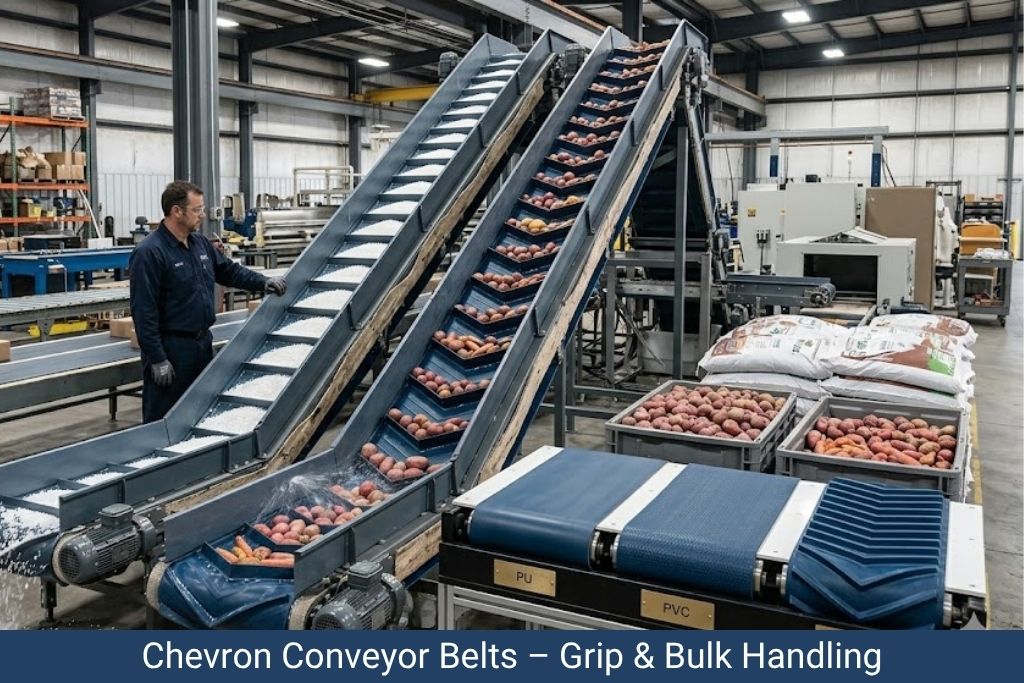
Chevron conveyor belts, also called herringbone belts or V-pattern belts are a specialised category defined by their distinctive raised-V or herringbone surface profile moulded into the carrying surface. The base material may be rubber or PVC, but it is the profile geometry that defines their performance advantage.
Chevron conveyor belt core properties:
- Raised chevron pattern (typically 15mm to 40mm cleat height) grips loose, granular, or root-vegetable products on steep inclines
- Prevents product rollback and spillage at conveyor angles of up to 35–40 degrees
- Self-cleaning action as the belt travels around return rollers
- Available in both open-V and closed-V chevron profiles for different product types
- Generally heavier-duty construction than cleated PU belts — suited to bulk and agricultural loads
PU vs PVC vs Chevron Conveyor Belts: The 4-Question Decision Framework
Rather than a simple specification sheet, experienced buyers rely on a trusted conveyor belt supplier in India to make belt selection decisions by working through four questions in sequence.
Question 1: Industry and Hygiene Standard: Which Conveyor Belt Meets Your Compliance Requirement?
| Industry / Application | Recommended Belt |
|---|---|
| Food processing — direct product contact | PU conveyor belt (food-grade) |
| Pharmaceutical / tablet / capsule lines | PU conveyor belt (FDA-compliant) |
| Packaging — product sorting and wrapping | PU or PVC (hygienic grade) |
| Dairy, bakery, confectionery production | PU conveyor belt (white, food-safe) |
| Agriculture — grain, seed, root vegetables | Chevron conveyor belt (rubber or PVC base) |
| Mining, quarrying, aggregates | Chevron conveyor belt (heavy-duty) |
| General manufacturing and warehousing | PVC conveyor belt (cost-efficient) |
| Chemical industry — mild chemicals | PU conveyor belt (chemical-resistant grade) |
The rule of thumb: If your product touches the belt and will later be consumed by a human being, specify PU. If your product is bulk, granular, or unprocessed and travels at a steep incline, specify Chevron. For everything in between, PVC is usually the most cost-effective answer.
Question 2: Conveyor Angle of Inclination: Which Conveyor Belt Handles Your Slope?
| Incline Angle | Recommended Belt Solution |
|---|---|
| 0° – 15° (flat to gentle slope) | Flat PU or PVC belt |
| 15° – 25° (moderate incline) | Cleated PU or PVC belt / Rough-top PU or PVC |
| 25° – 35° (steep incline) | Chevron belt / Sidewall PU or PVC belt |
| 35° – 90° (near-vertical to vertical) | Sidewall PU or PVC belt with corrugated walls |
This is the most commonly misunderstood selection criterion. Buyers frequently install a flat belt on a 20-degree incline, experience constant product rollback, and blame the belt but when the real issue is specifying the wrong profile for the angle. For inclines above 20 degrees, you need cleats, a chevron profile, or sidewalls. No surface friction alone is sufficient for reliable steep-angle conveyance of loose products.
Our Other Product
Filter Conveyor BeltsQuestion 3: Product Being Conveyed: Which Conveyor Belt Protects Your Material?
| Product Type | Best Belt Choice |
|---|---|
| Biscuits, cookies, packaged snacks | Cleated PU conveyor belt (food-grade, gentle cleat) |
| Fresh fruits and vegetables | Cleated PU or Chevron (food-grade) |
| Bulk grains and seeds | Chevron conveyor belt (agriculture grade) |
| Tablets, capsules, pharma products | Smooth PU conveyor belt (pharmaceutical grade) |
| Dairy — milk, cheese, butter products | Cleated or smooth PU (white, food-grade) |
| Packaged goods — cartons and pouches | Flat PVC or PU (smooth or textured) |
| Chemical powder and granules | PU (chemical-resistant) or Sidewall PU belt |
| Aggregates, gravel, coal | Chevron belt (heavy-duty rubber base) |
| Light parcels and boxes | Flat PVC belt (multi-ply) |
Question 4: Total Cost of Ownership: Which Conveyor Belt Delivers the Best Long-Term Value?
| Priority | Recommended Approach |
|---|---|
| Lowest initial purchase cost | PVC conveyor belt (standard grade) |
| Lowest lifetime cost in hygienic applications | PU conveyor belt (longer service life, lower maintenance) |
| Best performance on steep inclines | Chevron or Sidewall PU conveyor belt |
| Compliance-driven — food or pharma audit | PU conveyor belt (food-grade certified) |
| Export — international compliance required | PU conveyor belt (FDA / EU certified) |
PU vs PVC vs Chevron Conveyor Belts: Head-to-Head Comparison
| Attribute | PU Belt | PVC Belt | Chevron Belt |
|---|---|---|---|
| Hygiene and food-grade compliance | Excellent | Moderate | Limited |
| Chemical resistance | Excellent | Moderate | Limited |
| Performance on flat conveyors | Very good | Very good | Not applicable |
| Performance on steep inclines | Excellent (cleated / sidewall) | Good (cleated) | Excellent |
| Service life in hygienic use | Very long | Moderate | Long |
| Initial unit cost | Higher | Lower | Moderate |
| Customisation range | Extensive | Extensive | Limited |
| Ease of deep cleaning | Very easy | Moderate | Moderate |
Common Mistakes Conveyor Belt Buyers Make and How to Avoid Them?
PVC belts used in food-contact applications to reduce cost - PVC belts, particularly non-food-grade variants, contain plasticisers that can migrate into food products and fail regulatory audits. The cost of a product recall or regulatory action dwarfs any belt price saving.
Flat belts installed on inclines above 15 degrees - This results in chronic product rollback, increased belt wear, and motor overload. Specify cleated, rough-top, or chevron profile from the outset.
Chevron belts selected for hygienic food applications - Chevron belts are excellent for agricultural and industrial bulk handling, but their V-profile grooves accumulate product residue and make deep cleaning difficult in HACCP-controlled environments.
Buying on price per metre without specifying ply count, width, or surface finish - Two belts quoted at the same price per metre can perform very differently in service. Always specify: material (PU or PVC), ply count, width, surface finish, cleat height if applicable, and compliance requirement.
Ignoring supplier export capability when procuring internationally - A conveyor belt manufacturer without documented export experience, packaging standards, customs documentation, and compliance certificates creates avoidable risk for buyers in the UAE, Africa, Southeast Asia, or Europe.
 Email Us Today!
Leading PU, PVC, and Chevron Conveyor Belts Manufacturing Partner
Jagruti Conveyor Belts Pvt. Ltd. has positioned itself as one of India's foremost manufacturers, exporters, and suppliers of the complete conveyor belt solutions spectrum for over two decades now serving PU conveyor belts, PVC conveyor belts, Chevron conveyor belts, Sidewall PU conveyor belts, Cleated separator belts, Diamond Top PVC Conveyor Belts, PVC Smooth Top Conveyor Belts, Multi V PVC Conveyor Belts, Rubber Conveyor belts, and specialised industrial variants in food-safe colors such as white, green, blue, and black, perfect for various industries.
Based in the industrial hub of India's material handling manufacturing ecosystem, Jagruti serves clients across India, the Middle East (UAE, Saudi Arabia, Qatar, Oman, Bahrain, Kuwait), Africa (Kenya, Nigeria, South Africa), Southeast Asia (Malaysia, Indonesia, Vietnam), and Europe.
Jagruti Conveyor Belts Pvt. Ltd. ensures complete control over quality and specifications through its in-house manufacturing process, eliminating the need for middlemen. This guarantees consistency and timely delivery. The company’s engineering team is dedicated to providing the ideal belt tailored to your application, hygiene standards, and cost-efficiency requirements.
Contact Jagruti Conveyor Belts Pvt. Ltd. today — request a technical consultation, compliance documentation, and a competitive quotation for your PU, PVC, or Chevron belt requirements.
PU, PVC, and Chevron Conveyor Belts: FAQs
PU belts offer superior food-grade compliance and chemical resistance, ideal for food, dairy, and pharmaceutical applications, while PVC belts are more cost-effective for general industrial use but have a shorter service life in hygienic environments.
Jagruti Conveyor Belts Pvt. Ltd. in Ahmedabad, Gujarat, manufactures PU, PVC, and Chevron belts, providing a wide range of options for various industrial needs with consistent quality and consolidated shipping.
Chevron belts are ideal for bulk or agricultural material handling at steep inclines, while Cleated PU belts are better for food and pharmaceutical products requiring food-grade compliance.
The conveyor belt manufacturing industry is concentrated in Gujarat, with Ahmedabad housing top manufacturers like Jagruti Conveyor Belts, known for high-quality products and export capability.
Chevron belts are typically priced similarly to PVC belts but are often slightly higher than PU belts, though suitability for the application should determine selection, not cost alone.
Smooth or cleated PU belts in food-grade white are ideal for pharmaceutical manufacturing, meeting FDA and EU standards and resisting cleaning chemicals, preventing product contamination.
PVC conveyor belts come in 1-ply to 4-ply constructions and various finishes, including smooth, cleated, and sidewall, tailored for different load capacities, conveyor lengths, and hygiene requirements.
Indian conveyor belts are mainly exported to the UAE, Saudi Arabia, South Africa, Malaysia, Indonesia, and Southeast Asia, benefiting from competitive pricing and reliable quality.
Key factors include belt surface quality, resistance to lubricants and adhesives, consistency in production, availability of non-standard widths, and reliable lead times - criteria Jagruti addresses through in-house manufacturing and quality testing.