
Rubber Chevron Conveyor Belt: What to Look for Before Buying from Manufacturers and Suppliers in India?
Rubber Conveyor Belt Manufacturers in India:
This article helps to make a fully informed decision to buy rubber conveyor belt when plant engineers and business owners across India does the sourcing work. It covers quality parameters, belt specifications, supplier selection criteria, and the difference between rubber and PU conveyor belts so you avoid costly mistakes and choose the right manufacturing partner like Jagruti Conveyor Belts Pvt. Ltd., Ahmedabad's leading conveyor belt manufacturer and exporter with over 40 years of industry expertise.
Rubber Conveyor Belt Buying in India: Why Getting It Right the First Time Matters?
If you're sourcing a rubber conveyor belt for your plant, warehouse, or material-handling operation, the decisions you make before placing an order can save you lakhs in downtime, premature replacements, and operational inefficiencies. And when it comes to a chevron conveyor belt designed with V-shaped profiles for inclined or steep conveying — the stakes are even higher. The right belt doesn't just move material; it moves your business forward.
India has emerged as one of the most competitive markets for conveyor belt manufacturing. From Ahmedabad and Gujarat to pan-India supply chains, buyers today have access to world-class rubber conveyor belt manufacturers in India but only if they know exactly what to evaluate before signing a purchase order.
The challenge isn't a lack of options it's the opposite. With dozens of conveyor belt suppliers in India competing on price, it's easy to shortlist the wrong manufacturer: one who delivers a belt that looks right but fails within months. A mismatched belt increases spillage, damages your conveyor structure, and creates unplanned stoppages that cost far more than the belt itself. The checklist ahead will help you buy with confidence.
 Call Now!
Rubber Conveyor Belt Quality: Why Material Composition is the Starting Point?
Before comparing prices, start with what the belt is actually made of. The rubber compound its grade, hardness, and elasticity determines how long your conveyor belt will last under load, temperature, and abrasion.
When evaluating any rubber conveyor belt manufacturer, ask for the following:
- Rubber grade certification - Natural rubber, SBR, or a compound blend suited to your application?
- Cover grade - For quarry or mining use, look for M24 or N17 rated covers per IS/DIN standards.
- Ply construction - Multi-ply fabric carcass gives tensile strength and flexibility. Verify the ply count matches your load requirement.
- Top and bottom cover thickness - Thicker top covers resist abrasion on inclined runs; bottom covers protect the carcass from pulley wear.
One often-overlooked factor is the adhesion between the rubber covers and the fabric carcass. Poor inter-ply adhesion is a leading cause of premature belt delamination — especially on inclined applications where tension and flexing are continuous. Always ask for peel strength test data alongside the standard compound specs.
A reputable rubber conveyor belt manufacturer in Gujarat like Jagruti Conveyor Belts Pvt. Ltd. established since 1983 will proactively share test reports and compound specifications rather than waiting to be asked. That transparency is itself a quality signal worth paying attention to.
Chevron Conveyor Belt Profile: Matching the Pattern to Your Application
Not all chevron conveyor belts perform the same way. The height, pitch, and angle of the cleats directly determine grip capacity on inclines and suitability for different material types.
Key parameters to evaluate:
- Cleat height - Available from 6 mm to 32 mm. Higher cleats handle steeper inclines (up to 40°) and coarser materials like gravel, coal, or sand.
- Cleat pitch - Narrower pitch gives more grip on fine materials; wider pitch suits lumpy or large aggregate loads.
- Open vs. closed chevron - Open "V" profiles allow drainage in wet environments. Closed patterns suit fine powders or granules.
- Base belt compatibility - The chevron profile must be vulcanized onto a carcass matched to your conveyor's width, speed, and tension rating.
If your conveyor runs beyond 18°–20° inclination, a standard flat conveyor belt simply won't retain material. The chevron conveyor belt system exists precisely for this scenario and specifying the wrong cleat profile means costly spillage, rework, and lost productivity.
It's also worth noting that the rubber compound of the chevron belt itself must match the material being conveyed. For abrasive materials like crushed stone or coal, an abrasion-resistant rubber grade is essential even on the cleat surface. For sticky or damp materials, the rubber formulation affects whether material releases cleanly from the cleats or builds up over time causing imbalance and accelerated wear on your conveyor system.
PU Conveyor Belt vs. Rubber: Choosing the Right Material for Your Industry
Many buyers in food processing, pharmaceuticals, and packaging now opt for a PU conveyor belt over traditional rubber. Both have their place - the choice depends on your industry and operating conditions.
| Conveyor Type | Best For | Key Advantages |
|---|---|---|
| Polyurethane Conveyor Belt | Food processing, Pharmaceuticals, Packaging |
|
| Rubber Conveyor Belt | Heavy-duty bulk handling (Mining, Cement, Aggregates) |
|
A growing number of buyers are also opting for PU PVC conveyor belt types where PVC provides the structural body and PU delivers the working surface. This hybrid approach is increasingly common in packaging lines, logistics sortation, and light assembly operations where both durability and hygiene matter.
Jagruti Conveyor Belts Pvt. Ltd. manufactures and supplies both PU PVC conveyor belts and rubber-based belts across a wide range of industries. As one of the leading PU conveyor belt manufacturers in Ahmedabad, Gujarat, India Jagruti offers fully custom polyurethane conveyor belt solutions in widths, lengths, and surface finishes tailored to your exact machinery and application needs.
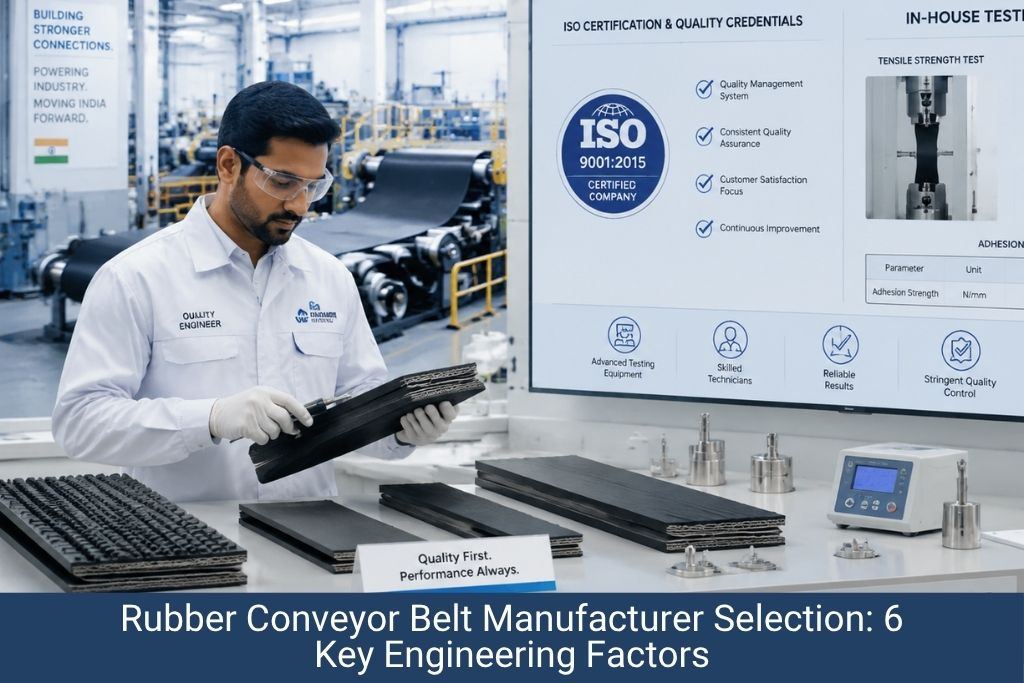
Rubber Conveyor Belt Manufacturer Selection: 6 Critical Factors
Choosing among rubber conveyor belt manufacturers in India requires more than a price comparison. Here are the six factors that genuinely matter:
- ISO Certification and Quality Credentials riVefy ISO 9001 compliance. It signals systematic quality control - not just good intentions.
- In-House Testngi Can the manufacturer test tensile strength, elongation, and adhesion in-house? A credible rubber conveyor belt manufacturer in Gujarat backs every claim with lab data, not assumptions.
- Product Range Depth Look for suppliers covering the full spectrum from elevator rubber conveyor belts and heat -resistant grades to Polyurethane Conveyor Belt Suppliers capabilities for food-safe or cleanroom applications. A narrow product range is a sign of limited engineering depth.
- Customization Capability Off-the-shelf belts often mean compromise. Your conveyor geometry is unique; your belt should fit it precisely - custom width, length, cover grade, and cleat profile are all fair asks from a serious manufacturer.
- Technical Support The best PU conveyor belt exporters and manufacturers help you specify the right belt for your application - speed, load, and inclination. Look for engineers who ask the right questions, not just salespeople who quote the lowest price.
- After-Sales Service What happens when a belt fails during a critical production run? Emergency breakdown support is non-negotiable for high-uptime operations. Jagruti Conveyor Belts Pvt. Ltd. provides emergency breakdown service as part of its "All Conveyor Solution" commitment covering installation, maintenance contracts, vulcanizing, splicing, and rapid belt replacement across India.
Conveyor Belt Specifications: The Technical Checklist Before You Order
Whether buying a conveyer belt system, an elevator rubber conveyor belt, or a Polyurethane Conveyor Belt, always confirm these specifications in writing before any order is placed:
- Belt width (mm) - Must match your conveyor frame exactly
- Belt length (meters) - Total loop length, not just one side
- Tensile strength (N/mm or kN/m) - Matched to your drive system's pull capacity
- Cover grade - Abrasion, heat-resistant, oil-resistant, or food-grade
- Ply count - Directly impacts flexibility and load rating whether 1 ply / 2 ply / 3 ply / 4 ply conveyor belt
- Cleat height and pitch (for chevron belts) - As discussed in the profile section above
- Operating temperature range - Critical for heat-resistant or cold-storage environments
- Compliance standard - IS 1891, DIN 22102, or equivalent international standard
Getting every specification confirmed in writing eliminates the single most common source of disputes between buyers and conveyor belt suppliers in India and protects your investment from day one.
Why Buy from Rubber Conveyor Belt Manufacturers in Gujarat and Ahmedabad?
Gujarat and Ahmedabad in particular is one of India's premier industrial manufacturing hubs. Buyers sourcing from rubber conveyor belt suppliers in Gujarat benefit from proximity to major ports (Mundra, Kandla), a dense raw material ecosystem, competitive pricing, and a strong engineering heritage built over decades.
Beyond supply chain advantages, Ahmedabad-based manufacturers increasingly service export orders - meaning their quality benchmarks align with international buyer expectations. Jagruti Conveyor Belts Pvt. Ltd., headquartered in Ahmedabad, is a full-service conveyor belt solutions company manufacturing, supplying, installing, and servicing the complete range. As trusted PU conveyor belt suppliers and exporters, Jagruti serves both domestic industries and international procurement teams who demand verified quality and reliable delivery from India.
FAQs: Rubber Chevron Conveyor Belt — Buyers' Key Questions
Few manufacturers combine production capability, technical depth, and full after-sales support under one roof. Jagruti Conveyor Belts Pvt. Ltd., based in Ahmedabad, Gujarat — operating since 1983 offers a comprehensive range including chevron, PU, elevator, and heavy-duty rubber belts.
Pricing depends on belt width, cleat height, cover grade, ply count, and order quantity — typically ranging from ₹300 to ₹1,200+ per meter. Polyurethane Conveyor Belts are priced higher due to specialized compound materials. Contact Jagruti Conveyor Belts directly for a specification-based quotation.
Chevron conveyor belts are used across mining, quarrying, cement, fertilizer, agriculture, port handling, and construction anywhere bulk material needs to move at 18°–40° inclines. They are installed on inclined belt conveyors, stackers, reclaim systems, and loading/unloading setups.
Replace when you observe cleat wear beyond 50% of original height, cover cracking or carcass exposure, persistent slippage on inclines, or visible edge fraying. Scheduled inspection every 3–6 months is recommended. Jagruti offers maintenance contracts and belt replacement services across India.
A chevron conveyor belt or rough top conveyor belt is the recommended choice. It combines food-grade material compliance with the incline grip required for grains, pulses, or processed food. Leading rough top conveyor belt suppliers like Jagruti manufacture food-safe chevron profiles in custom widths to match your conveyor exactly.
📞 Ready to discuss your requirement? Visit jagruti.co to explore the full product range of conveyor belt systems or connect with their technical team for a customized solution.