
How to Select the Right Cleat Type and Height for Your PVC Cleat Conveyor Belt?
If you have ever watched a PVC cleat conveyor belt struggling to hold material on a steep incline, or seen product sliding back because the cleats were simply not the right height, you already know how critical this decision is. Choosing the wrong cleat type or height is one of the most common and costly mistakes in conveyor system design, and yet it is entirely avoidable with the right knowledge.
This guide walks you through exactly how to make that decision, whether you are specifying a PVC cleated conveyor belt for a new installation or replacing a worn belt on an existing system.
Why Cleat Type and Height Selection Is Critical for PVC Conveyor Belt Performance?
A PVC conveyor belt with cleats does not just move material from one point to another. It controls the movement. The cleats are what give the belt authority over the material it carries, especially the moment gravity starts working against you.
Pick a cleat that is too short, and material rolls back down the incline before it reaches the discharge point. Pick one that is too tall, and the belt cannot flex properly around the pulley, causing stress cracks at the cleat base and premature belt failure. Get the cleat profile wrong for the material type, and you create buildup, spillage, or contamination problems.
The right cleated PVC conveyor belt is always a product of three things working together: the application, the material being conveyed, and the physical design of the conveyor system.
 Call Now!
PVC Cleat Conveyor Belt Cleat Types and Their Industrial Applications
Before getting into selection criteria, it helps to understand what cleat types are actually available and what each one is designed to do.
T-Cleat PVC Cleat Conveyor Belts: Best for Dry and Packaged Products
T-cleats, also called flat or straight cleats, run horizontally across the belt width and present a flat face to the material. They are the most common type used on PVC cleat conveyor belts for general-purpose inclined conveying of dry, granular, or packaged goods. Their simple geometry makes them easy to clean and they cause minimal disturbance to the product, which matters in food processing and pharmaceutical applications.
C-Cleat PVC Cleated Conveyor Belts: Designed for Loose and Free-Flowing Materials
C-cleats have a curved profile that forms a shallow pocket between the cleat and the belt surface. This pocket actively retains material rather than just blocking it, which makes C-cleats the preferred choice for loose, wet, or free-flowing materials like grain, sand, fertiliser, and coal fines. A PVC cleated belt with C-cleats will outperform a T-cleat belt significantly when the material has any tendency to run or slide.
V-Cleat PVC Conveyor Belts: For Wide Belt Edge Control and Material Centring
V-cleats are used on wide belts where material needs to be guided towards the centre of the belt as it travels. The V-profile channels material inward, which reduces edge spillage on wide inclined applications. They are commonly seen in agricultural sorting lines and recycling conveyors where material distribution across belt width can be unpredictable.
Box Cleat PVC Cleat Conveyor Belts: Maximum Containment for Difficult Materials
Box cleats form a closed compartment structure on the belt surface, making them the most aggressive containment option. They are used for materials that are extremely prone to rollback, such as wet roots, tubers, bulky food products, and irregularly shaped objects. The trade-off is that box cleats require larger pulley diameters and more careful system design to accommodate the belt's reduced flexibility.
Sawtooth and Wedge Cleat PVC Cleated Belts: For Steep Incline Specialised Handling
Sawtooth cleats have an angled face designed for specific incline angles and material types where a straight face would not provide enough grip. They are popular in steep-incline applications involving root vegetables, bulky agricultural produce, and certain mining materials.
How to Choose the Right Cleat Type for Your PVC Conveyor Belt?
The cleat type selection comes down to four practical questions you need to answer about your application.
Matching PVC Conveyor Belt Cleat Height to Material Particle Size
Dry, packaged, or rigid products like cartons, bottles, and bags do well with T-cleats because the material naturally rests against the cleat face without needing containment. Loose, granular, powdery, or wet materials need C-cleats or box cleats that actively hold the material in a pocket rather than just blocking it.
On a PVC cleated conveyor belt used in food processing, the choice between T and C-cleats often comes down to whether the product is a finished packaged item or a raw loose ingredient. Biscuits, chocolates, and sealed pouches typically use T-cleats. Loose seeds, grain, and wet produce need C-cleats.
How Incline Angle Determines PVC Cleat Conveyor Belt Cleat Height Requirements
For incline angles up to 20 degrees, most T-cleat designs handle the job adequately. Between 20 and 35 degrees, you should strongly consider C-cleats or bucket-style cleats, especially if the material is loose or has any moisture content. Beyond 35 degrees, box cleats or sidewall cleated belt configurations become necessary to prevent rollback entirely.
This is why PVC PU conveyor belts designed for steep incline applications almost always come with C or box-type cleats pre-bonded, because a flat T-cleat at a 40-degree incline is essentially decorative.
How fragile is your product?
Delicate products like fresh pastries, tablet blister packs, and assembled electronic components cannot tolerate aggressive cleats because the cleat face can bruise, chip, or damage the product on impact. For these applications, low-profile soft T-cleats on a cleated PU conveyor belt are the right specification. The polyurethane conveyor belt material softens the contact while the cleat profile is kept shallow and gentle.
Does hygiene and cleanability matter?
In food-grade and pharmaceutical conveying, cleat geometry directly affects how easy or difficult the belt is to clean. Complex profiles, especially box cleats and C-cleats with deep pockets, can trap residue, bacteria, and allergens if not specified correctly. For these environments, a PVC conveyor belt with cleats in a simple T or shallow C profile is far easier to sanitise, and the PVC conveyor belt material should be food-grade compliant.
PVC and PU Conveyor Belts Industry Specific Cleat Selections
Cleat height is expressed in millimetres and refers to how far the cleat projects above the belt surface. Standard heights typically range from 15mm at the lower end to 100mm and beyond for heavy-duty applications. Here is how to think through the height selection.
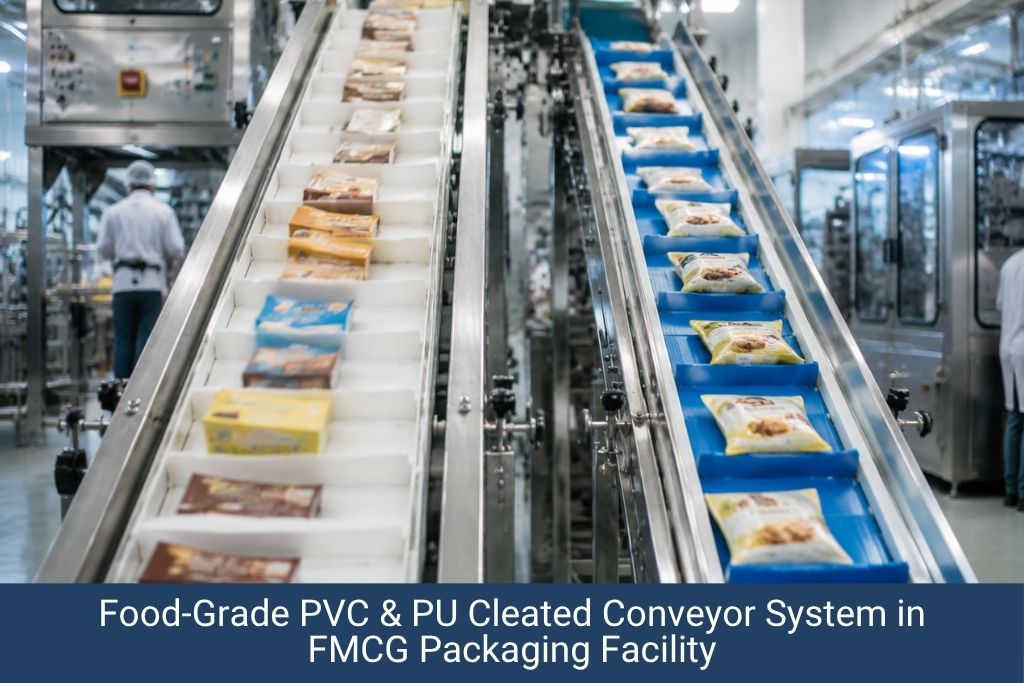
Food Processing and FMCG: PVC PU Conveyor Belt with T or Shallow C-Cleats
In food processing, the PVC PU conveyor belt with shallow T or C-cleats is the standard specification for inclined transport of finished products, packaged goods, biscuits, chocolates, and dairy items. The PVC conveyor belt material in these applications must be food-grade compliant, and the cleat compound must also be certified for food contact where the material touches the cleat face directly.
Cleated PU conveyor belts are preferred over pure PVC in premium food-grade applications because polyurethane offers a softer, more hygienic surface that is easier to clean and less prone to harbouring bacteria in surface microfissures. PU Conveyor Belt Manufacturers in Ahmedabad, Gujarat supply extensively to food manufacturers in India and export to food processing plants across the Middle East and Southeast Asia.
Pharmaceutical Manufacturing: Cleated PU Conveyor Belts with Low Profile T-Cleats
Pharmaceutical production lines require cleated PU conveyor belts with very low profile, smooth-face T-cleats that provide just enough retention force for gentle inclined transport without causing any impact bruising or surface contamination on tablets, capsules, or blister packs.
The priority in pharmaceutical conveying is cleanability and product integrity rather than aggressive material retention. Cleat heights of 15mm to 25mm with wide pitch spacing are typical. The PU Conveyor Belt material must meet pharmaceutical-grade compliance requirements, and both the belt body and cleat compound should be documented accordingly.
Bulk Material Handling and Mining: Rubber Conveyor Belt and Heavy Duty Cleated Configurations
For heavy bulk material handling in mining, quarrying, and construction, the rubber conveyor belt with C or box cleats is the dominant specification. The elevator rubber conveyor belt used in bucket elevator systems is a separate but related product designed for vertical bulk conveying at high loads, while inclined surface conveyors in the same environment typically use C-cleated rubber or PVC cleated belt configurations.
Rubber conveyor belt manufacturers in Gujarat supply heavy-duty cleated belts for mining and quarrying applications with cleat heights of 60mm to 100mm and reinforced cleat bonding to handle the repeated shock loading of dense, abrasive materials.
Agriculture and Recycling: V-Cleats and C-Cleats on PVC Cleat Conveyor Belts
Agricultural sorting lines and recycling facilities benefit most from V-cleat and C-cleat configurations on PVC cleat conveyor belts. The irregular shapes and varying densities of agricultural produce and recyclable materials make V-cleats valuable for centring loads on wide belts, while C-cleats provide the pocket containment needed for loose, wet, or tumbling materials at moderate incline angles.
 Email Us Today!
Common Mistakes to Avoid on PVC Conveyor Belts
Many operators end up with a poorly performing PVC cleat conveyor belt not because they chose the wrong belt, but because they overlooked these practical points.
Specifying maximum cleat height to feel safe is a mistake. Taller cleats are not always better. They restrict belt flexibility, increase wear on pulley lagging, and can damage fragile products. Always match height to actual need rather than over-engineering.
Ignoring material moisture content is another common error. Wet or sticky materials behave very differently from dry ones on inclined belts. A T-cleat profile that works perfectly for dry grain will allow the same material to slide straight over it when wet. Know your material in its worst-case condition and specify accordingly.
Forgetting about the return side is a mistake that catches many buyers out. Tall cleats on the return side of a PVC cleated conveyor belt can catch on scrapers, belt cleaners, and structure if the system was not designed to accommodate them. Always inform your conveyor system supplier of the cleat height when planning belt cleaner and scraper positions.
Our Other Product
Heavy Duty Conveyor Belt Manufacturers in Ahmedabad, Gujarat, IndiaWhat to Ask Your PVC Conveyor Belt Manufacturer or Supplier Before Ordering?
Even a correctly specified cleat profile and height will underperform if the manufacturing quality is poor. The bond between the cleat and the belt body is the most critical factor in cleat longevity. A cleat that separates from the belt surface after a few weeks of operation is a specification failure, but it is also a manufacturing quality failure.
When sourcing a PVC cleated conveyor belt, choose PVC conveyor belt manufacturers who can demonstrate controlled manufacturing processes, consistent cleat bond strength testing, and material certifications for the base belt compound. PVC conveyor belt suppliers and PU conveyor belt manufacturers based in Ahmedabad and Gujarat have developed significant expertise in producing cleated belts for demanding export applications, and their production facilities are well equipped to deliver on custom cleat configurations.
For applications requiring food-grade compliance, ask specifically for documentation confirming that both the PVC conveyor belt material and the cleat compound meet the applicable food safety standards.
Best PVC Cleat Conveyor Belt Partner
Selecting the right cleat type and height for your PVC cleat conveyor belt is not a decision to make on instinct or by copying what was used previously. It requires a clear understanding of your material, your incline angle, your product fragility, your cleaning requirements, and the physical constraints of your conveyor system.
Start with the cleat type that suits your material behaviour, then determine the height by working backward from your incline angle and particle size. Confirm the pulley diameter requirements and cleat pitch before committing to a specification, and always source from a manufacturer who can back their product with proper bond strength data and material certifications.
Jagruti Conveyor Belts Pvt. Ltd., based in Ahmedabad, Gujarat, manufactures and supplies Cleated PU Conveyor Belts and PVC conveyor belts with cleats across a wide range of industries. Their engineering team works with buyers to specify the correct cleat type, height, pitch, and base belt configuration for every application. Whether you need a PVC PU conveyor belt for a food-grade inclined application or a heavy-duty PVC cleated belt for bulk material handling, Jagruti has the product range and the technical expertise to deliver the right solution.
Visit jagruti.co to explore their full conveyor belt range or to get in touch with their team for a customised recommendation.
FAQs on PVC Cleat Conveyor Belts
T-cleats suit dry and packaged goods, C-cleats handle loose and wet bulk materials, V-cleats centre material on wide belts, box cleats offer maximum containment on steep inclines, and sawtooth cleats work best for agricultural and mining applications. Consult a PVC conveyor belt manufacturer in Ahmedabad to confirm the right profile for your material and incline angle.
Cleat height should be 1.5 to 2 times the maximum particle size of your material. For inclines up to 20 degrees, 20mm to 30mm heights are standard. For 20 to 30 degree inclines, 30mm to 50mm is typical. Beyond 35 degrees, 60mm to 100mm with C or box cleats is the correct specification on a PVC cleat conveyor belt.
A PVC cleated conveyor belt is cost-effective and suited to general industrial and logistics applications. A cleated PU conveyor belt offers superior hygiene, softer product contact, and food-grade compliance, making it the preferred choice in food processing and pharmaceutical manufacturing. PU Conveyor Belt Manufacturers in Gujarat supply both configurations for domestic and export markets.
Up to 20 degrees, T-cleats on a PVC conveyor belt with cleats handle most applications adequately. Between 20 and 35 degrees, C-cleats become necessary for loose materials. Beyond 35 degrees, box cleats or a PVC PU conveyor belt with tall cleats is required to prevent rollback entirely.
PVC conveyor belt manufacturers in Ahmedabad from Gujarat offer fully custom cleat configurations at competitive PVC conveyor belt price points, supplying to the Middle East, Southeast Asia, and Europe. Jagruti Conveyor Belts Pvt. Ltd. in Ahmedabad is a trusted manufacturer and exporter of PVC cleat conveyor belts and the complete range of industrial conveyor belts with full technical support.