
What Is a PVC Sidewall Conveyor Belt and Where Is It Used in Modern Industries?
Sidewall PVC Conveyor Belt Manufacturers in Ahmedabad, Gujarat, India:
This article explains what a PVC Sidewall Conveyor Belt is, how it works, what makes it technically distinct from standard conveyor belts, and which industries rely on it most. It also covers the broader range of PVC conveyor belt types available from Jagruti Conveyor Belts Pvt. Ltd., a leading PVC conveyor belt manufacturers, suppliers, and exporters based in India to help procurement professionals and plant engineers find the right belt solution for their specific application.
PVC Sidewall Conveyor Belt Built for Vertical Material Handling
In most industrial conveyor setups, the belt moves material horizontally or at a modest incline. But what happens when your plant layout demands steep inclines, near-vertical elevation, or space-efficient vertical lifting of bulk material? That's the problem a PVC Sidewall Conveyor Belt is purpose-engineered to solve and it does so in a way that flat conveyor belts and standard inclined conveyors simply cannot match.
A Sidewall Conveyor Belt is a specially structured belt fitted with raised corrugated sidewalls along both edges and, in most configurations, cross-cleats or base cleats at regular intervals along the belt surface. Together, these three components - the base belt, the sidewalls, and the cleats create individual enclosed pockets or "buckets" that hold bulk material in place even as the belt climbs steep angles of up to 90 degrees.
This is not a niche or specialized product limited to one or two industries. As modern manufacturing, logistics, and processing plants push for space optimization and higher throughput, the pvc sidewall conveyor belt system has become a standard material-handling solution across agriculture, mining, recycling, cement, chemicals, and food processing sectors, both in India and globally.
How PVC Sidewall Conveyor Belt Works and What Sets It Apart?
Understanding the engineering behind a sidewall conveyor belt system helps buyers appreciate why it outperforms alternatives in steep-incline and vertical conveying scenarios.
The three structural elements that define performance:
- Corrugated Sidewalls - These flexible, wave-form walls are vulcanized or bonded to the edges of the base belt. They expand and contract as the belt curves around pulleys without cracking or delaminating, maintaining their sealing function throughout the belt's lifecycle. The height of the sidewalls typically ranging from 40 mm to 200 mm — determines the volume of material each pocket can carry.
- Base Cleats - Transverse cleats fixed across the belt surface at measured intervals act as floors for each material pocket. They prevent the load from sliding down under gravity as the belt inclines steeply. Cleat profiles vary — T-type, C-type, and L-type — each suited to different material sizes and flow characteristics.
- Base Belt Construction - The PVC compound used in the base belt provides the structural backbone. It must be flexible enough to run around pulleys without fatigue cracking, yet strong enough to handle the tensile load of a fully loaded steep-incline run.
What distinguishes a pvc sidewall conveyor belt from a rubber sidewall belt variant is the material composition. PVC offers better resistance to oils, greases, mild chemicals, and moisture making it the preferred choice in food processing, pharmaceuticals, packaging, and chemical handling environments where contamination control and hygienic surface properties matter. PVC also offers excellent dimensional stability, lower elongation under load, and easier splicing compared to many rubber alternatives.
PVC Sidewall Conveyor Belt Industrial Applications Across Modern Sectors
The versatility of the sidewall pvc conveyor belt is one of its strongest selling points. Here is where it delivers measurable operational value:
Agriculture and Grain Handling Grain elevators, seed processing units, and fertilizer plants use sidewall belts to lift grains, seeds, pulses, and fertilizer granules vertically with minimal footprint. The enclosed pocket design prevents spillage and grain damage critical in food-grade handling where yield loss directly affects profitability. Jagruti's sidewall pvc belts are engineered to handle bulk agricultural materials efficiently, with customizable pocket dimensions to suit different grain types and throughput volumes.
Mining and Quarrying Coal handling plants, stone crushing units, and mineral processing facilities require belts that can transport heavy, abrasive bulk materials — coal, sand, gravel, crushed stone at steep angles within the tight spatial constraints of a mine or quarry setup. A sidewall pvc conveyor belt handles these demands without the large horizontal footprint that a conventional inclined belt conveyor would require.
Recycling and Waste Management Modern recycling facilities deal with mixed material streams glass, plastic, cardboard, metal scrap that vary widely in size, weight, and surface characteristics. Sidewall conveyor belts in recycling plants provide controlled vertical transport of these heterogeneous loads, feeding sorting lines, shredders, or compactors without spillage or blockage.
Cement and Construction Materials Cement plants and ready-mix concrete batching units use sidewall belts to elevate raw materials like fly ash, slag, gypsum, and clinker directly into silos or mixing chambers. The sealed pocket design prevents dust emission during transport, supporting both operational cleanliness and environmental compliance.
Chemical and Pharmaceutical Processing In chemical plants and pharmaceutical manufacturing, the ability to transport powders, granules, and intermediate materials vertically in a controlled, contained manner is operationally critical. The PVC surface resists most mild acids, alkalis, and solvents reducing contamination risk and extending belt service life compared to standard rubber conveyor belt in similar environments.
PVC Sidewall Conveyor Belt vs. Standard Inclined Belt
Plant engineers evaluating conveyor options for steep-incline applications often compare the sidewall pvc belt against a standard inclined belt conveyor with chevron conveyor belt or rough top pvc conveyor belt surface. The differences are significant:
- A standard inclined conveyor belt typically handles inclines up to 30°–35° reliably. Beyond that, material rollback, spillage, and reduced throughput become unavoidable problems. A sidewall conveyor belt operates efficiently at inclines from 30° right up to 90° near-vertical without material loss.
- A standard inclined conveyor at steep angles requires a longer horizontal run to achieve the required elevation change. A sidewall belt achieves the same elevation in a fraction of the horizontal distance, which is a decisive advantage in space-constrained facilities.
- Total cost of ownership over time is also lower with a sidewall belt in steep-incline applications, because you eliminate the secondary containment, spillage cleanup, and structural length associated with a flatter belt run.
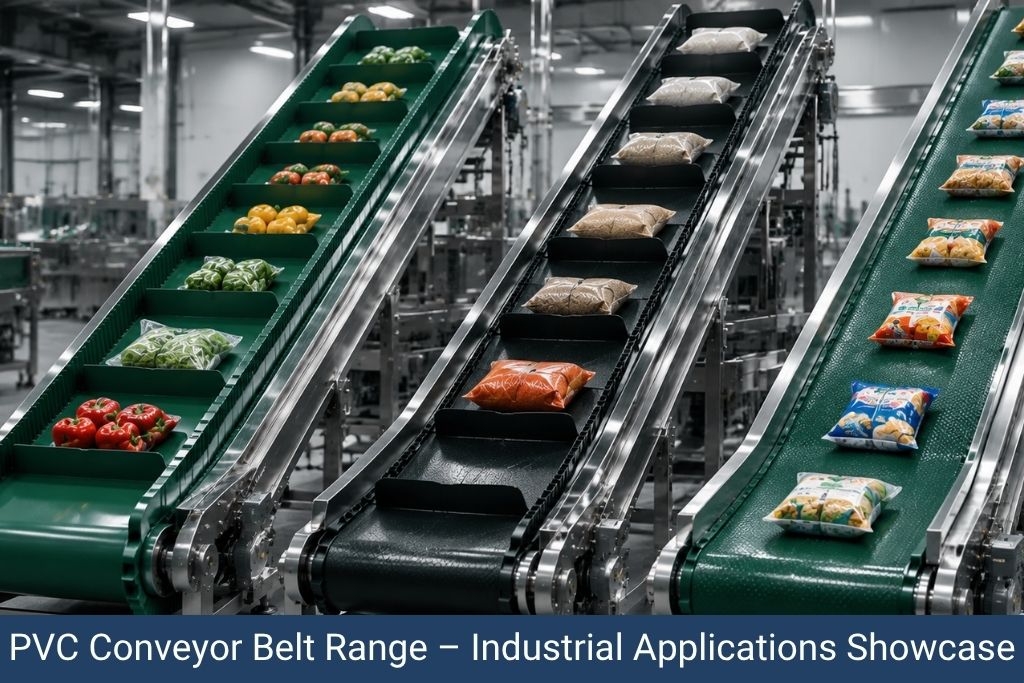
PVC Conveyor Belt Range: Other Solutions from Jagruti Conveyor Belts
While the Sidewall PVC Conveyor Belt is the focus of this article, buyers should be aware that Jagruti Conveyor Belts Pvt. Ltd. manufactures a comprehensive range of PVC conveyor belt types for varied industrial applications. Briefly:
- Cleated PVC Conveyor Belt - Raised cleats for inclined transport of packaged goods, vegetables, and bulk items; widely used in food processing and logistics.
- Rough Top PVC Conveyor Belt - Textured surface for anti-slip transport of heavy or bulky items on inclines; popular in construction, automotive, and frozen food handling.
- Diamond Top PVC Conveyor Belt - Diamond-pattern surface for abrasion resistance and slip prevention; suited to food and beverage packaging lines.
- Multi V PVC Conveyor Belt - Multiple V-grooves for precise lateral control in textile, packaging, and small-parts handling.
- Treadmill PVC Conveyor Belt - Engineered for low-friction, smooth, quiet operation in fitness equipment and light industrial continuous-run applications.
Our Other Product
PU Conveyor Belt Manufacturers in Ahmedabad, Gujarat, IndiaEach of these PVC belt types is manufactured using base fabrics including polyester, nylon, cotton, solid woven, and fiberglass with top surface coatings in Rubber, PVC, PU, or Silicone depending on the application. Available widths go up to 4,600 mm, with belt ratings from 30 to 300 kN/m, 1 to 4 ply construction, and thickness from 1 mm upward.
 Email Us
Why Choose Jagruti Conveyor Belts as Your PVC Sidewall Conveyor Belt Manufacturer in India?
Jagruti Conveyor Belts Pvt. Ltd., established in 1983 and headquartered in Ahmedabad, Gujarat, is one of India's most experienced and comprehensive conveyor belt manufacturers. As a trusted PVC conveyor belt manufacturer, supplier, and exporter, Jagruti brings four decades of engineering knowledge to every product it makes.
What sets Jagruti apart when it comes to Sidewall PVC Conveyor Belts specifically:
- Engineered Customization - Pocket height, cleat type, base belt width, sidewall profile, and belt length are all configurable to your exact conveyor geometry and material handling requirement. There are no generic, off-the-shelf compromises here.
- Material Versatility - Jagruti's PVC sidewall belts are available in multiple colors and surface finishes, with chemical-resistant and food-grade compound options depending on your industry's compliance requirements.
- Quality Assurance - Every belt undergoes rigorous quality checks across material selection, fabrication, and final testing - ensuring the product performs under real-world operating conditions, not just laboratory benchmarks.
- Full-Service Capability - Beyond supply, Jagruti handles conveyor belt installation, commissioning, maintenance contracts, vulcanizing and splicing services, and emergency breakdown support - making it a genuine single-vendor solution for Indian industries and international buyers alike.
- Export-Ready - As an established exporter, Jagruti supplies PVC Sidewall Conveyor Belts and the full PVC belt range to international markets, with documentation and quality credentials aligned to global procurement standards.
FAQs: PVC Sidewall Conveyor Belt - What Buyers Need to Know
A PVC Sidewall Conveyor Belt has corrugated sidewalls bonded along its edges and cross-cleats on its surface, forming enclosed pockets that hold bulk material at steep inclines — up to 90 degrees vertical. A standard flat conveyor belt has no sidewalls and is limited to inclines of roughly 30°–35° before material spillage becomes a problem.
Agriculture (grain and seed elevators), mining and quarrying (coal, sand, gravel), recycling and waste processing, cement and construction materials, and chemical and pharmaceutical manufacturing are the primary sectors. Any operation requiring vertical or steep-incline bulk material transport is a candidate for sidewall belt technology.
Pricing depends on belt width, sidewall height, cleat type and spacing, base fabric, PVC compound grade, and total belt length required. As a leading PVC conveyor belt manufacturer in Ahmedabad, Jagruti provides specification-based quotations — contact jagruti.co for pricing tailored to your conveyor configuration.
Ahmedabad and Gujarat are home to some of India's most established conveyor belt manufacturers. Jagruti Conveyor Belts Pvt. Ltd., operating since 1983, is a well-regarded manufacturer, supplier, and exporter of PVC Sidewall Conveyor Belts from Ahmedabad — serving industries across India and international markets.
Service life depends on material type, inclination angle, operating speed, and load volume — but well-specified PVC sidewall belts in appropriate applications typically deliver several years of reliable service. Regular inspection of sidewall bond integrity, cleat wear, and base belt tension is recommended every 3–6 months. Jagruti offers maintenance contracts and belt inspection services to help you protect your investment.